
Many people believe stubborn belly fat is simply a result of eating too much.
So they cut calories.
They train harder.
They reduce portions.
But the lower belly doesn’t change.
Here’s the truth:
Not all belly fat is driven by calories alone.
In many cases, it’s driven by hormones, stress patterns, sleep disruption, and blood sugar instability.
If your belly fat behaves in certain ways, it may not be a “discipline problem.”
It may be a hormonal environment issue.
Let’s break it down.
1️⃣ You Gain Fat Mostly Around Your Lower Stomach
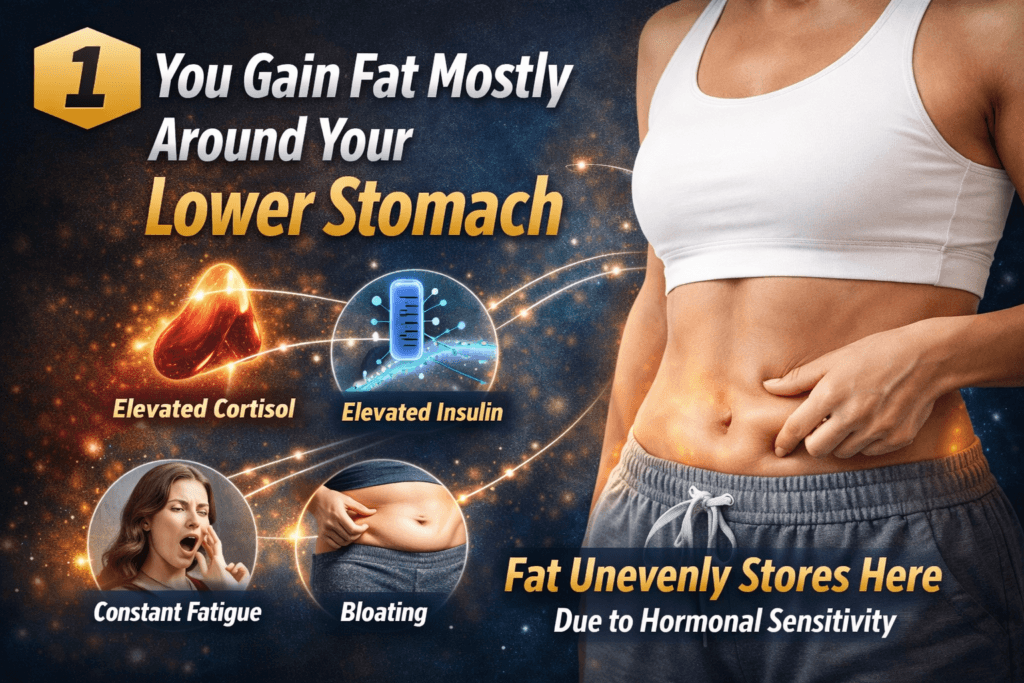
If most of your weight gain accumulates in your lower belly—even when the rest of your body stays relatively lean—this is often a hormonal signal.
Research in endocrinology shows that abdominal fat tissue is highly sensitive to cortisol and insulin (Harvard Health Publishing; Endocrine Reviews).
Chronic stress increases cortisol.
Elevated cortisol encourages fat storage around the abdomen.
This is why high-stress lifestyles often show up physically around the midsection.
Read: why Your lower belly fat is so stubborn
2️⃣ You Feel Bloated Even When You Eat “Clean”

If your stomach looks flat in the morning but distended by evening, that isn’t always fat gain.
It can be:
- Digestive inflammation
- Fluid retention
- Stress-induced gut sensitivity
- Microbiome imbalance
Research published in the Nutrients Journal shows gut health significantly influences waist circumference and inflammation levels.
Sometimes what you call “fat” is inflammation.
(Read More: Why you wake up puffy and bloated)
3️⃣ You’re Tired But Wired
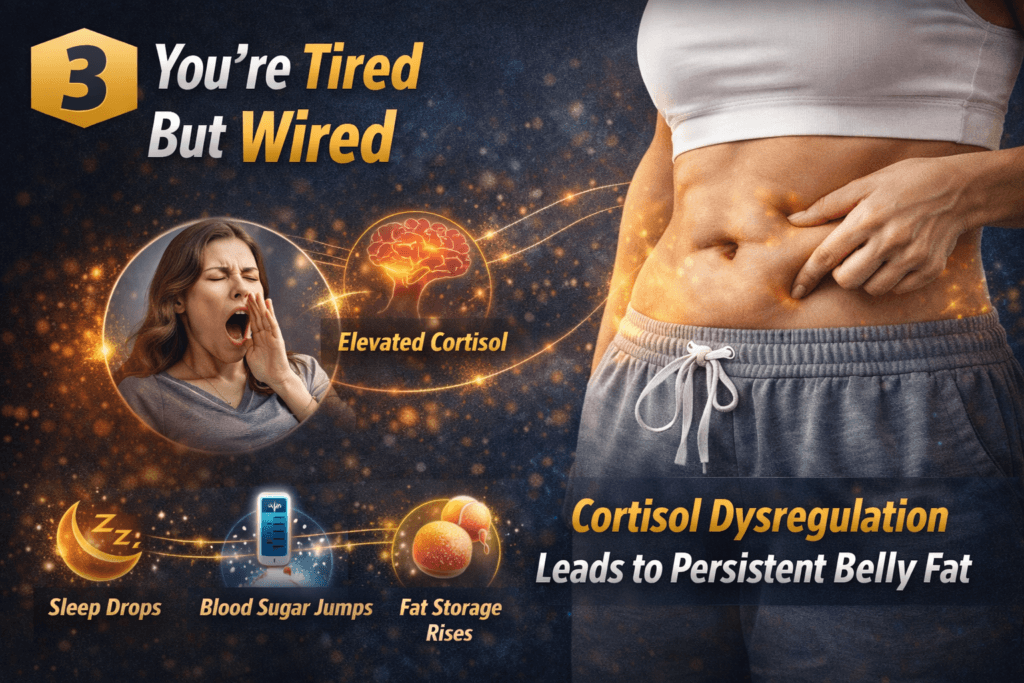
Do you feel exhausted but can’t fully relax?
That pattern often signals elevated cortisol.
Chronic stress disrupts circadian rhythm, increases abdominal fat storage, and impairs fat oxidation (Epel et al., Psychoneuroendocrinology).
When cortisol stays elevated:
- Fat burning decreases
- Blood sugar becomes unstable
- Cravings increase
- Sleep quality drops
And stubborn belly fat becomes harder to lose.
This isn’t a willpower problem.
It’s a stress regulation problem.
4️⃣ You Crave Sugar at Night
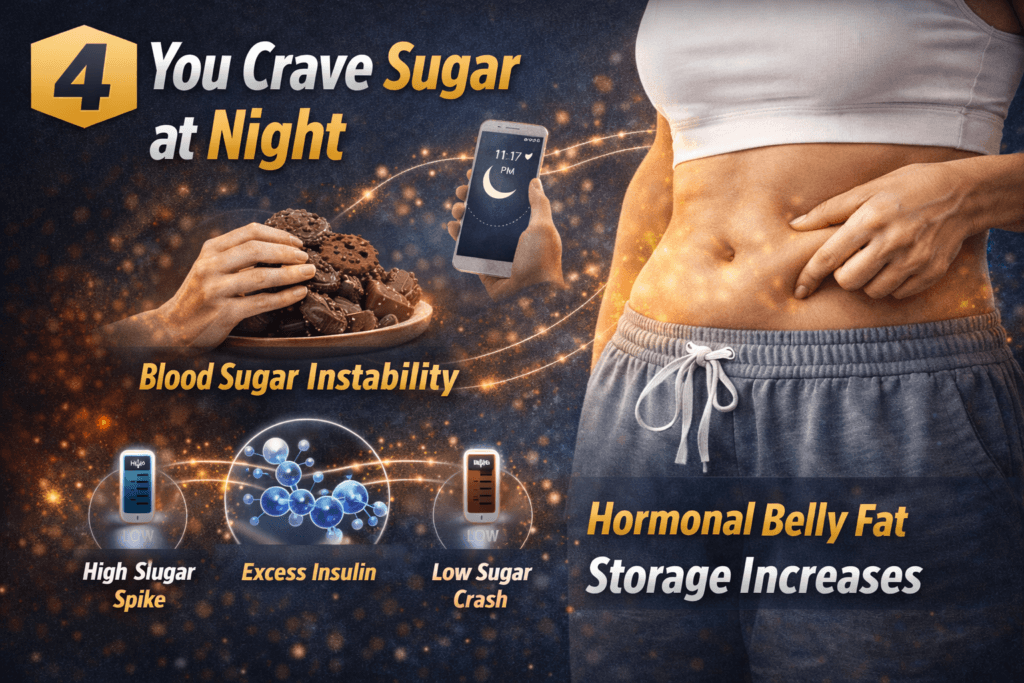
If evenings trigger strong sugar cravings, this may reflect blood sugar instability.
Repeated spikes and crashes in blood glucose increase insulin levels. Chronically elevated insulin reduces the body’s ability to burn fat efficiently (Journal of Clinical Investigation).
Insulin is a storage hormone.
If it remains elevated:
- Fat burning slows
- Abdominal fat storage increases
- Energy becomes unstable
This is why simply “eating less” often fails.
(Read: How Flat Stomach vs Low Body Fat work.)
5️⃣ You Sleep Poorly (And Wake Up Puffy)
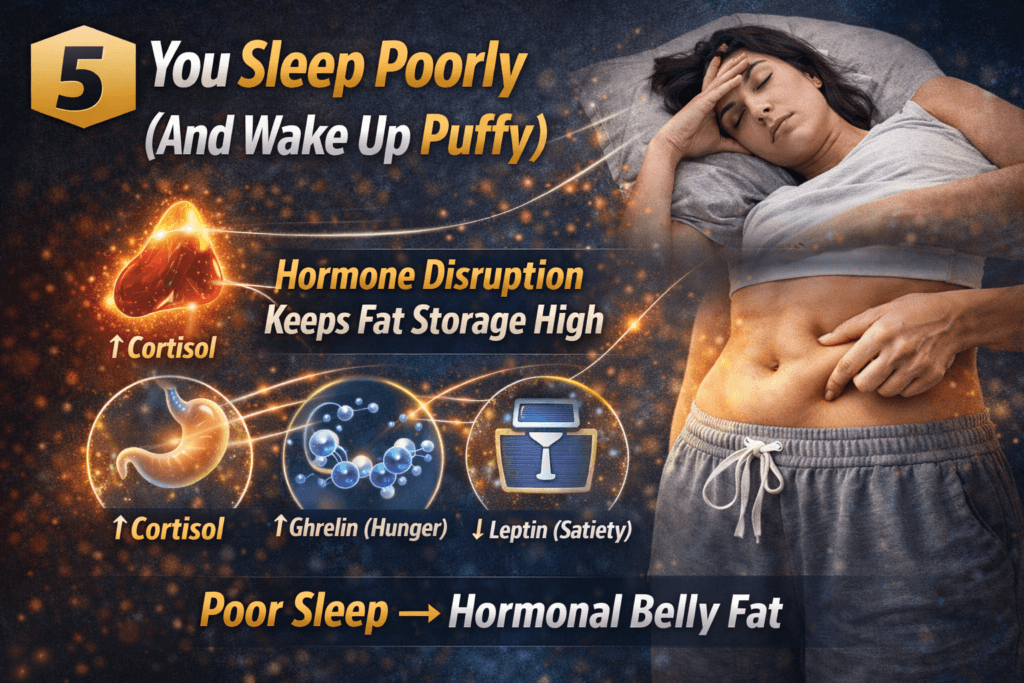
Sleep is one of the strongest regulators of fat metabolism.
A study published in the Annals of Internal Medicine showed that sleep deprivation significantly reduces fat loss while increasing fat retention.
Poor sleep:
- Raises cortisol
- Increases ghrelin (hunger hormone)
- Reduces leptin (satiety hormone)
- Promotes abdominal fat storage
If you wake up puffy or bloated, it’s often a stress + sleep issue, not a calorie issue.
Why Calorie Cutting Alone Doesn’t Fix Hormonal Belly Fat
Extreme calorie restriction increases physiological stress.
The body responds by:
- Slowing metabolism
- Increasing stress hormones
- Preserving abdominal fat as protective storage
Research in the American Journal of Clinical Nutrition shows metabolic adaptation during aggressive dieting can reduce fat-burning efficiency.
This is why sustainable, hormone-aware strategies outperform crash diets long-term.
What Actually Helps Reduce Hormonal Belly Fat?
Instead of cutting more calories, focus on stabilizing your internal environment.
✔ Morning sunlight exposure
✔ Protein-rich breakfast
✔ Blood sugar stability
✔ Consistent sleep schedule
✔ Stress regulation
✔ Digestive support
When hormones stabilize, the body becomes more willing to release stubborn abdominal fat.
Frequently Asked Questions (FAQ)
How do I know if my belly fat is hormonal?
If fat accumulates mainly around your lower stomach, fluctuates with stress levels, worsens with poor sleep, and doesn’t respond to calorie cutting, hormones may be involved.
Can stress really cause belly fat?
Yes. Chronic cortisol elevation is strongly associated with increased abdominal fat storage.
Can I reduce hormonal belly fat without extreme dieting?
Yes. Hormone stabilization through sleep, stress management, and blood sugar control is often more effective than aggressive calorie restriction.
How long does it take to see changes?
With consistent lifestyle improvements, noticeable changes can occur within 4–12 weeks depending on metabolic health.
Final Thoughts: Fix the Environment, Not Just the Diet
If you recognized yourself in several of these signs…
You don’t need another extreme diet.
You need a hormone-smart reset.
Your body responds to its internal environment.
When that environment improves, fat loss becomes easier and more sustainable.
Done for you reset plan
If stubborn belly fat has been frustrating you for months…
Stop guessing.
Start with the EasyFitIntro 7-Day Hormone Reset—designed to stabilize blood sugar, lower stress, and support sustainable fat loss.
👉 Download the 7-Day Reset and begin today.
Your metabolism doesn’t need punishment.
It needs balance.
EasyFitIntro.com
Coach Modisa