Introduction
Have you ever noticed something strange?
You feel exhausted all the time.
You don’t even eat that much.
But your belly keeps growing anyway.
That isn’t bad luck.
That is biology.
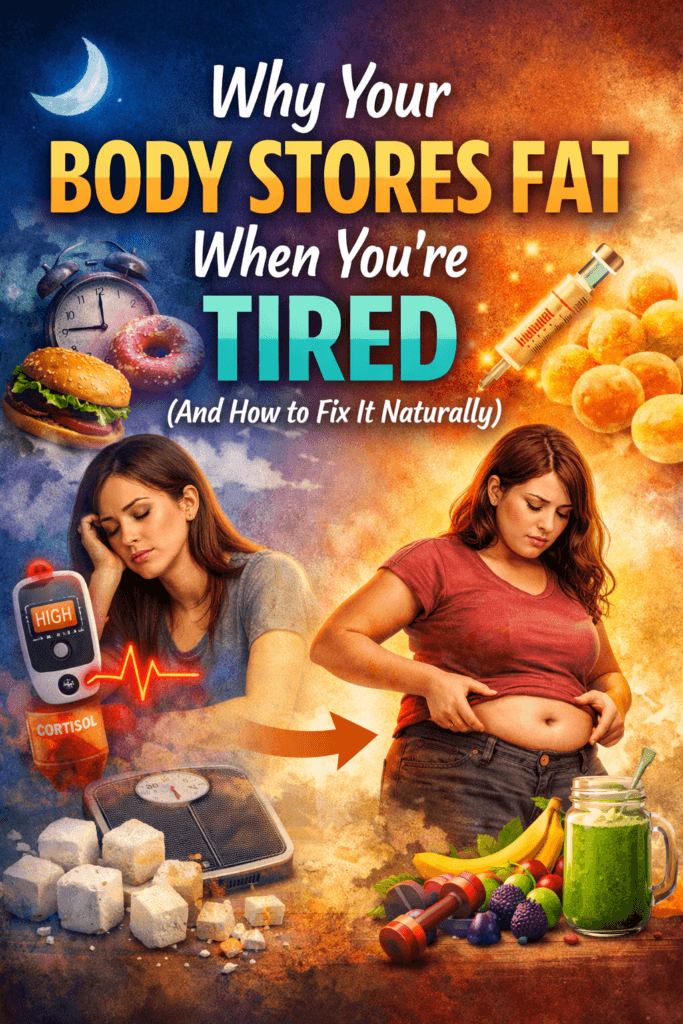
When your body is tired, it switches into fat-storage mode—not fat-burning mode.
And if no one ever explained this to you, you’ve been fighting the wrong enemy the whole time.
In this guide, you’ll learn:
- Why fatigue makes you store belly fat
- How blood sugar and stress hormones sabotage your metabolism
- How to restore energy so your body starts burning fat again
Research shows that persistent fatigue isn’t just tiring — it alters metabolism and fat storage. Multiple studies demonstrate that sleep loss, chronic stress, and blood sugar dysregulation all play roles in increasing fat accumulation and reducing fat loss potential.
🧬 The Survival Mode Most People Are Stuck In
Your body has only two modes:
| Mode | What Happens |
|---|---|
| Energy-Rich Mode | Burns fat, builds muscle, heals |
| Survival Mode | Stores fat, slows metabolism, craves sugar |
When you are tired, stressed, under-fed, or under-nourished…
Your body believes food is scarce and danger is near.
So it does this:
- Raises cortisol (stress hormone)
- Raises insulin
- Lowers metabolic rate
- Stores fat, especially in the belly
This is not weakness.
This is your ancient survival system.
🩸 How Blood Sugar Controls Fat Storage
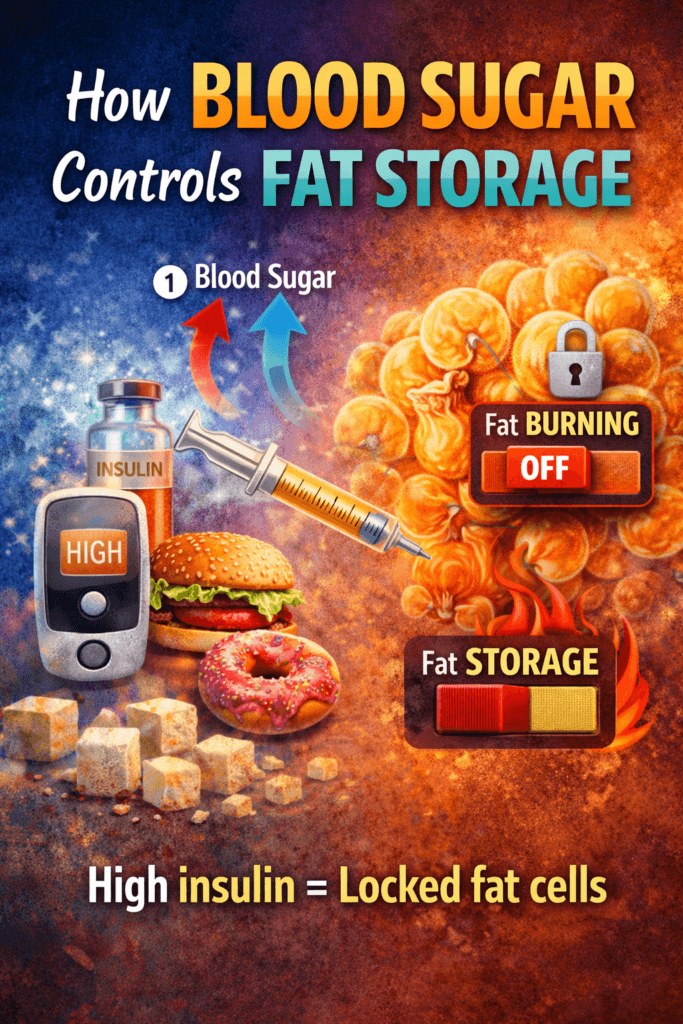
Every time you eat sugar, bread, cereal, or junk carbs, this happens:
- Blood sugar spikes
- Insulin rises
- Fat burning turns OFF
- Fat storage turns ON
High insulin = locked fat cells.
When this happens all day long, your body:
- Can’t access stored fat
- Feels tired
- Craves more sugar
- Stores more belly fat
This is why tired people get stuck in weight-loss plateaus.
🩸 How Blood Sugar Controls Fat Storage (Science Proof)
When you eat high-carb foods, blood glucose rises, and the pancreas releases insulin—a hormone that promotes glucose uptake but also signals the body to stop burning fat and start storing it. ³
This is confirmed by multiple metabolic studies showing insulin suppresses fat oxidation (fat burning) and enhances lipogenesis (fat storage). ³
Well-established research shows high insulin—triggered by sugar and refined carbs—prevents fat breakdown (lipolysis) and promotes fat storage. ³
Study: High glycemic loads → higher insulin → reduced fat oxidation
Reference: Ludwig et al., Journal of the American Medical Association (JAMA), 1999.
⚡ Why Fatigue Slows Your Metabolism
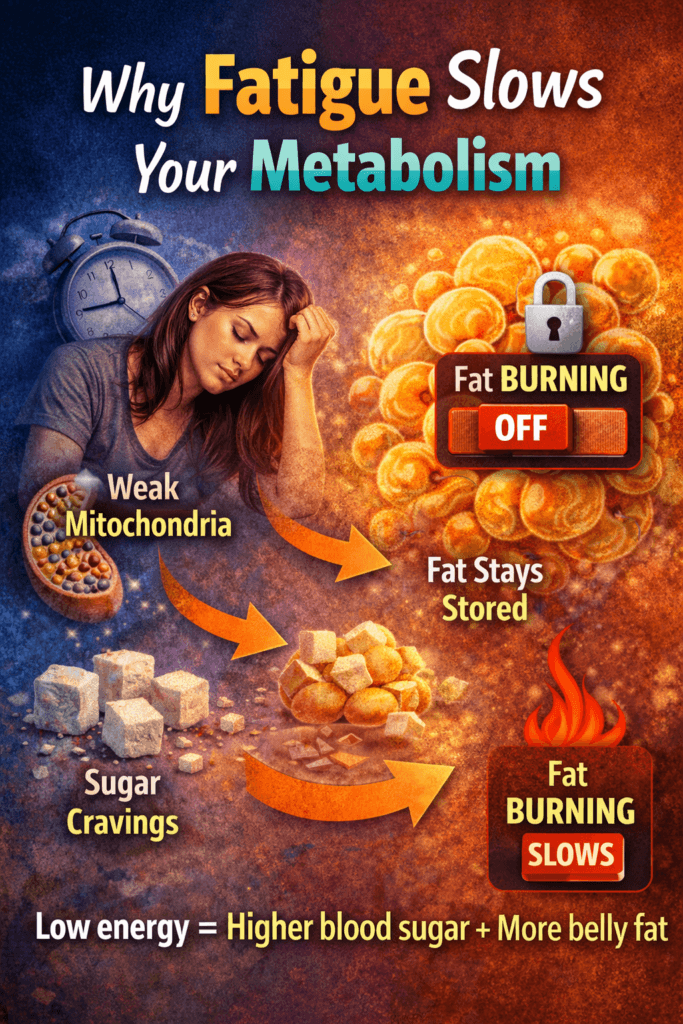
Low energy is not just “being sleepy.”
It means:
- Mitochondria (your energy factories) are weak
- Cells can’t burn fat efficiently
- Hormones become unbalanced
So your body chooses the fastest energy Source:
➡ Sugar.
And when sugar is gone?
➡ Hunger
➡ Cravings
➡ Fat storage
You are not failing.
Your metabolism is exhausted.
⚡ Why Fatigue Slows Your Metabolism (science says)
Mitochondria—the energy factories in cells—decrease efficiency under stress, sleep loss, and nutrient deficiencies. A study in the Journal of Clinical Endocrinology & Metabolism found that sleep deprivation alters metabolic rate and glucose metabolism. ⁴
Study: Sleep loss → impaired glucose metabolism & energy regulation
Reference: Spiegel et al., JCEM, 1999.
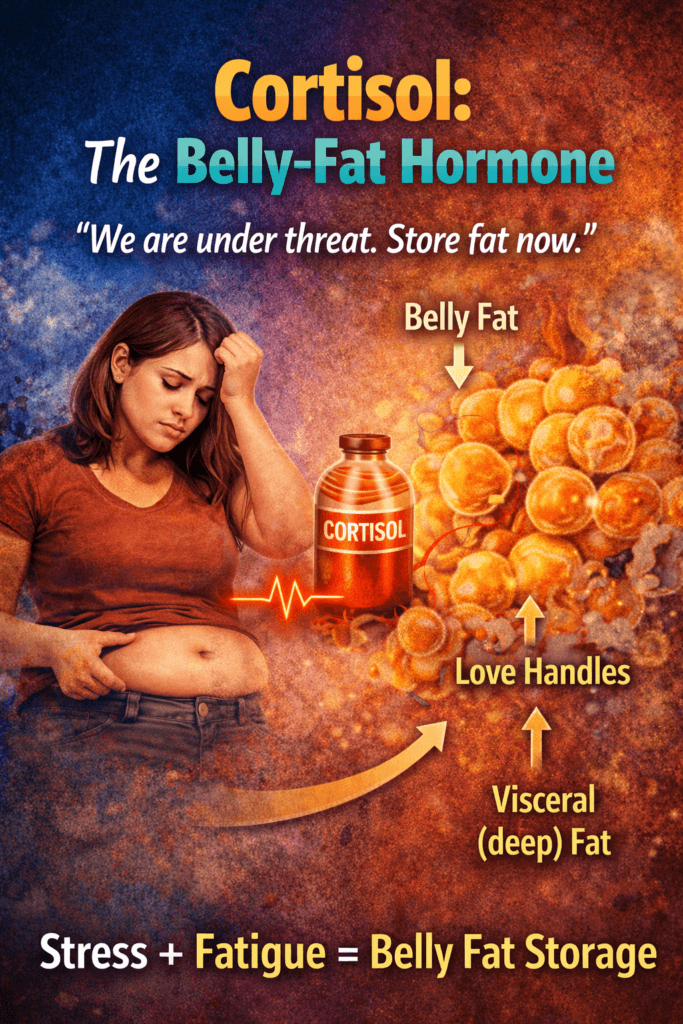
😵 Cortisol: The Belly-Fat Hormone
When you’re tired, your body releases cortisol.
Cortisol tells your body:
“We are under threat. Store fat now.”
Cortisol specifically pushes fat into:
- Lower belly
- Love handles
- Deep visceral fat
That is why stress + fatigue = stubborn belly fat.
😵 Cortisol: The Belly-Fat Hormone (This is what Science says)
The International Journal of Obesity shows that chronically elevated cortisol is correlated with increased visceral fat deposition. ⁵ Stress management isn’t just wellness—it’s biological.
Study: Cortisol correlates with visceral adiposity
Reference: Bjorntorp, Int J Obes, 2001.
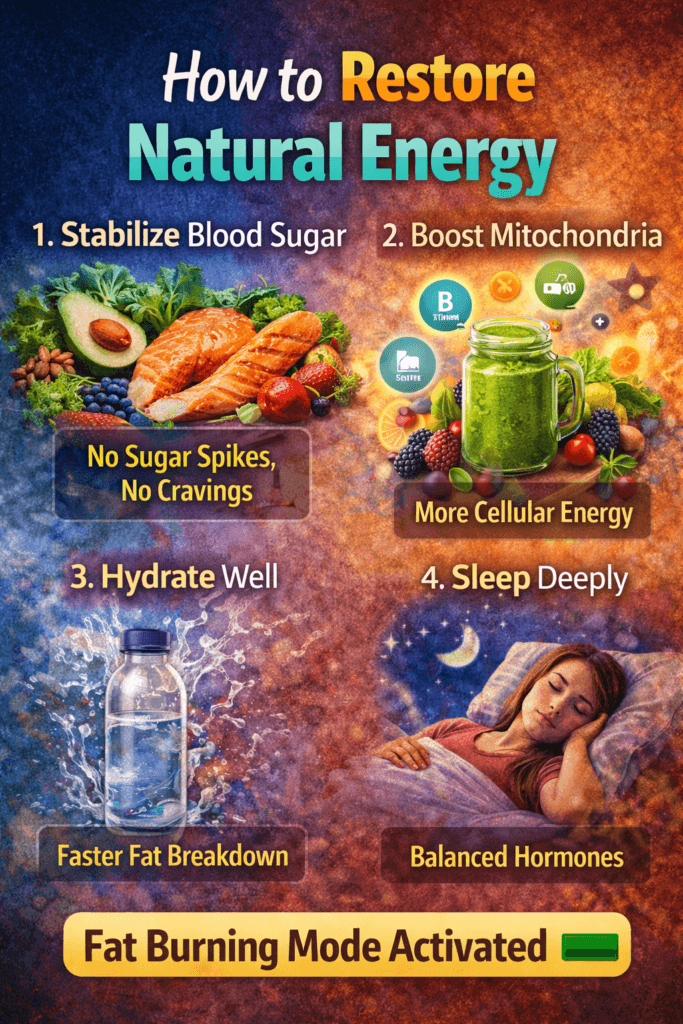
🥗 How to Restore Natural Energy (And Unlock Fat Burning)
Here’s how you flip the switch back to fat-burning mode.
1️⃣ Stabilize Blood Sugar
Eat foods that don’t spike insulin:
- Protein
- Fiber
- Healthy fats
- Low-sugar fruits
Avoid:
- Sugary drinks
- Bread & pastries
- Ultra-processed foods
🥗 How to Restore Natural Energy (Backed by Science)
1️⃣ Stabilize Blood Sugar
Fiber, healthy fats, and proteins slow glucose absorption and blunt insulin spikes, which studies show improves metabolic health. ⁶
Study: Low glycemic diets improve insulin sensitivity
Reference: Jenkins et al., American Journal of Clinical Nutrition, 2008.
2️⃣ Feed Your Mitochondria
Your energy comes from nutrients like
- Magnesium
- B-vitamins
- Antioxidants
- Healthy carbs from fruits & vegetables
- Nutrients for Mitochondrial Function
- B vitamins and antioxidants support cellular metabolism. A clinical review in Nutrients notes their role in energy production and metabolic regulation. ⁸
- Study: B-vitamins & antioxidants support energy metabolism
- Reference: Kennedy, Nutrients, 2016.
- Hydration = Metabolism
- Dehydration makes your body:
- Feel tired
- Slow fat burning
- Hold water weight
Water is required for fat breakdown.
Research shows even mild dehydration reduces energy expenditure and impairs fat oxidation. ⁷
Study: Hydration increases metabolic rate
Reference: Boschmann et al., Journal of Clinical Endocrinology & Metabolism, 2003.
4️⃣ Sleep = Fat Loss
Sleep controls:
- Insulin
- Cortisol
- Hunger hormones
Poor sleep = more belly fat.
4.1. Sleep Loss Raises Fat Storage
storage. A landmark study found that sleep restriction increases hunger and appetite, especially for calorie-dense foods, and increases insulin resistance—a key driver of fat storage. ¹
Study: Sleep restriction → higher insulin resistance and appetite
Reference: Nedeltcheva et al., Annals of Internal Medicine, 2010.
🥤 Why Smoothies Work So Well For Fatigue & Fat Loss
Smoothies are powerful because they:
- Deliver nutrients directly into your bloodstream
- Stabilize blood sugar
- Fuel mitochondria
- Reduce cravings
- Improve energy
That’s why people using the 21-Day Smoothie Diet often say:
“I have more energy, AND I’m losing belly fat.”
It’s not magic.
It’s biology.
👉 You can see how it works here:
🥤 Why Smoothies Can Help (Mechanistically)
Blending nutrient-dense foods improves nutrient availability and stabilizes blood glucose when formulated correctly. A randomized trial in overweight adults comparing whole foods and blended nutrient-rich diets showed improvements in satiety and metabolic profiles. ⁹
Study: Nutrient-rich blended diets improve satiety & metabolic markers
Reference: Li et al., Appetite, 2011.
❓ FAQ
Q: Can being exhausted really cause weight gain?
Yes. Fatigue raises cortisol and insulin, which tells your body to store fat.
Q: Why is my belly the hardest to lose?
Belly fat is most sensitive to stress hormones and blood sugar.
Q: Is cardio enough to fix this?
No. You can’t out-exercise hormonal imbalance.
Q: How fast can energy improve?
Many people feel better within 3–7 days of stabilizing blood sugar and nutrients.
Q: Are smoothies better than meals?
For tired people, yes—they digest easily and deliver nutrients fast.
- 🧠 REFERENCES
- Nedeltcheva et al., Ann Intern Med, 2010—Sleep restriction increases insulin resistance.
- Epel et al., Obesity, 2000—Stress & cortisol increase visceral fat.
- Ludwig et al., JAMA, 1999—High glycemic diets increase insulin & reduce fat oxidation.
- Spiegel et al., JCEM, 1999—Sleep loss impairs glucose metabolism.
- Bjorntorp, Int J Obes, 2001—Cortisol correlates with abdominal fat.
- Jenkins et al., Am J Clin Nutr, 2008—Low glycemic diets improve insulin sensitivity.
- Boschmann et al., JCEM, 2003—Hydration increases metabolism.
- Kennedy, Nutrients, 2016—Micronutrients & energy metabolism.
- Li et al., Appetite, 2011—Blended nutrient diets and metabolism.
🧠 Final Truth
You don’t gain weight because you’re lazy.
You gain weight because your body is exhausted and protecting itself.
Fix your energy…
And fat loss follows.
You don’t gain weight because you’re weak.
You gain weight because your biology reacts to:
✅ Sleep loss
✅ Stress hormones
✅ Blood sugar spikes
✅ Metabolic disruption
And science shows that it is not only real—it’s measurable.
💬 Your Turn
Have you been feeling exhausted, stuck, or frustrated with your weight?
Comment below and let’s talk. 👇