
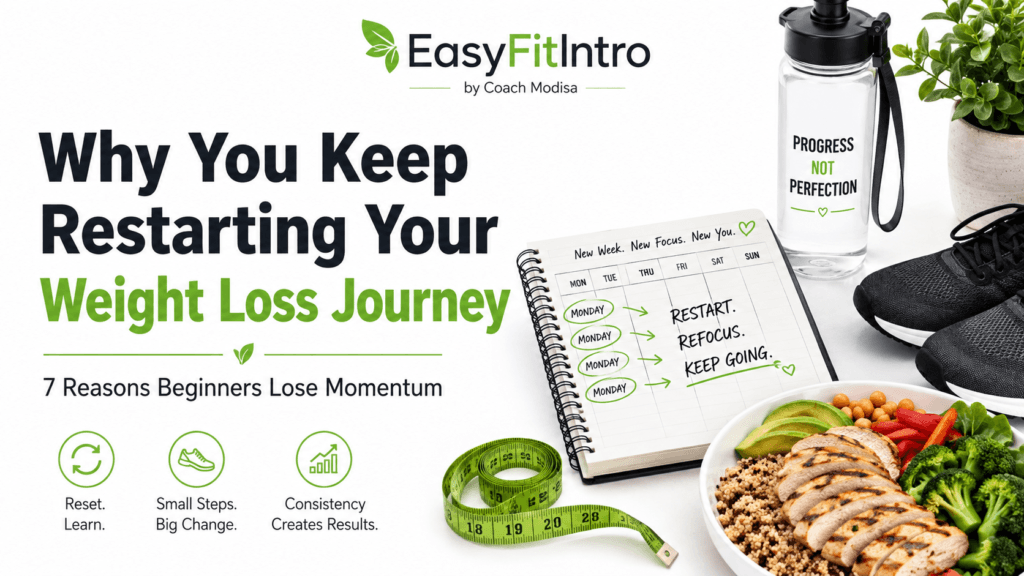
You start on Monday feeling determined.
You promise yourself that this time will be different.
You clean up your meals, drink more water, exercise for a few days, and maybe even start seeing small changes.
Then life happens.
You miss a workout. You eat something you did not plan. Work gets stressful. Your energy drops.
Suddenly, the routine disappears.
A few days later, you tell yourself:
“I’ll start again on Monday.”
If this pattern sounds familiar, you are not alone.
Many beginners struggle not because they are incapable of losing weight, but because they build plans that only work when life is going perfectly.
Sustainable progress requires something different.
You need a routine that can survive busy days, low motivation, mistakes, and unexpected situations.
Here are seven reasons you may keep restarting your weight loss journey—and what to do instead.
1. You Are Using an All-or-Nothing Mindset
One of the fastest ways to lose momentum is believing that one mistake ruins everything.
You eat takeaway and think the entire day is wasted.
You miss a workout and decide the whole week is ruined.
You have dessert and tell yourself you will restart next Monday.
This creates a cycle of perfection followed by quitting.
But one meal cannot undo several days of better habits.
One missed workout does not erase your progress.
The better question is not
“Did I mess up?”
Ask:
“What is my next helpful decision?”
That could mean drinking water, preparing a balanced dinner, taking a short walk or simply going to bed on time.
You do not need a restart.
You need a next step.
2. Your Plan Is Too Difficult to Maintain
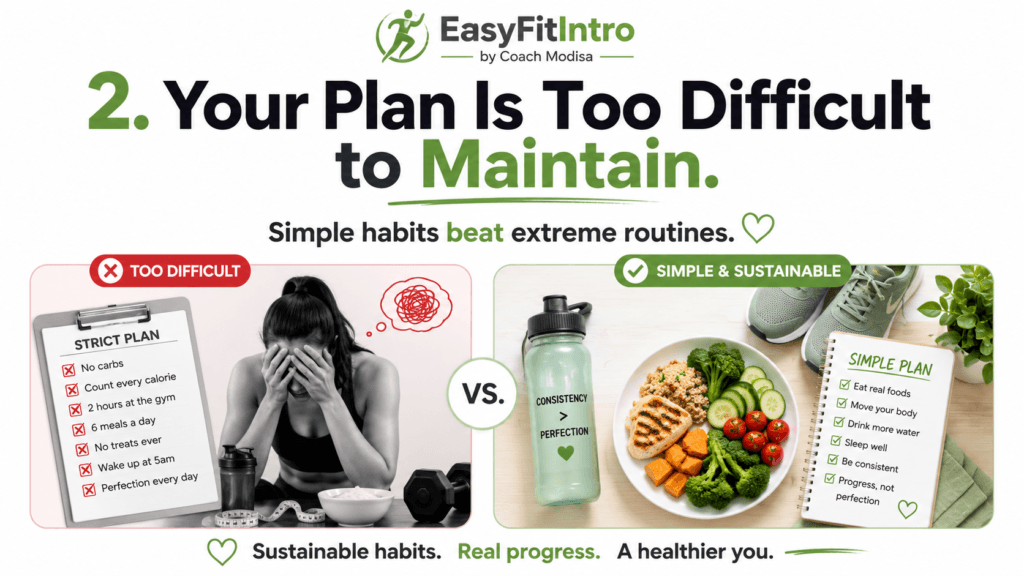
Some weight loss plans look impressive because they are extremely strict.
No carbohydrates.
No treats.
Long workouts every day.
Complicated meal preparation.
Very low calorie intake.
The problem is not always whether you can follow the plan for three days.
The real question is whether you can live that way for several months.
If your routine demands perfect discipline every day, eventually normal life will interfere.
A beginner plan should feel challenging enough to create change but realistic enough to repeat.
Instead of building the hardest routine possible, start with a few habits you can maintain consistently.
For example, improve one main meal, drink more water, walk regularly, and add simple strength training during the week.
Simple does not mean ineffective.
Simple means repeatable.
3. You Are Depending on Motivation
Motivation feels powerful when you have it.
The problem is that it changes.
Some mornings you will feel excited.
Other mornings you will feel tired, stressed, or distracted.
If your plan only works when you feel motivated, your consistency will always be unstable.
This is why systems matter more than motivation.
A system could be:
Walking after dinner.
Keeping your water bottle where you can see it.
Planning tomorrow’s breakfast before bed.
Doing a short beginner strength session on specific days.
Preparing a backup meal for busy evenings.
These small systems reduce the number of decisions you have to make.
You stop asking:
“Do I feel like doing this?”
It becomes part of your routine.
4. You Expect Results Too Quickly

Many beginners become discouraged because their expectations are much faster than their bodies.
After one week, they expect a dramatically smaller waist.
After several workouts, they expect the scale to drop immediately.
When this does not happen, they assume the plan is failing.
But progress does not always show first on the scale.
You may notice:
Less bloating.
Better energy.
Improved appetite control.
Fewer cravings.
More consistent walking.
Better sleep.
Clothes becoming slightly more comfortable.
These changes matter because they often show that your daily behavior is improving.
Body weight also naturally fluctuates because of water, food intake, digestion, and other factors.
Instead of judging your entire journey from one weigh-in, look at the direction of your habits over several weeks.
5. You Have No Plan for Difficult Days
Most weight loss plans are designed for perfect days.
You wake up on time.
You prepare every meal.
You exercise exactly as planned.
You sleep well.
But what happens when you work late?
What happens when you are exhausted?
What happens when takeaway is the only realistic dinner option?
You need a backup version of your routine.
Your normal day might include a 30-minute walk.
Your difficult-day version could be 10 minutes.
Your normal dinner may be home-cooked.
Your backup may simply be choosing protein, vegetables, and a reasonable carbohydrate portion from the best options available.
Your normal workout might contain several exercises.
Your backup could be one round of chair squats, wall push-ups, and standing knee raises.
Doing less is often better than disappearing completely.
Consistency is not doing everything perfectly.
Consistency is staying connected to the process.
6. You Keep Chasing New Plans Instead of Building One
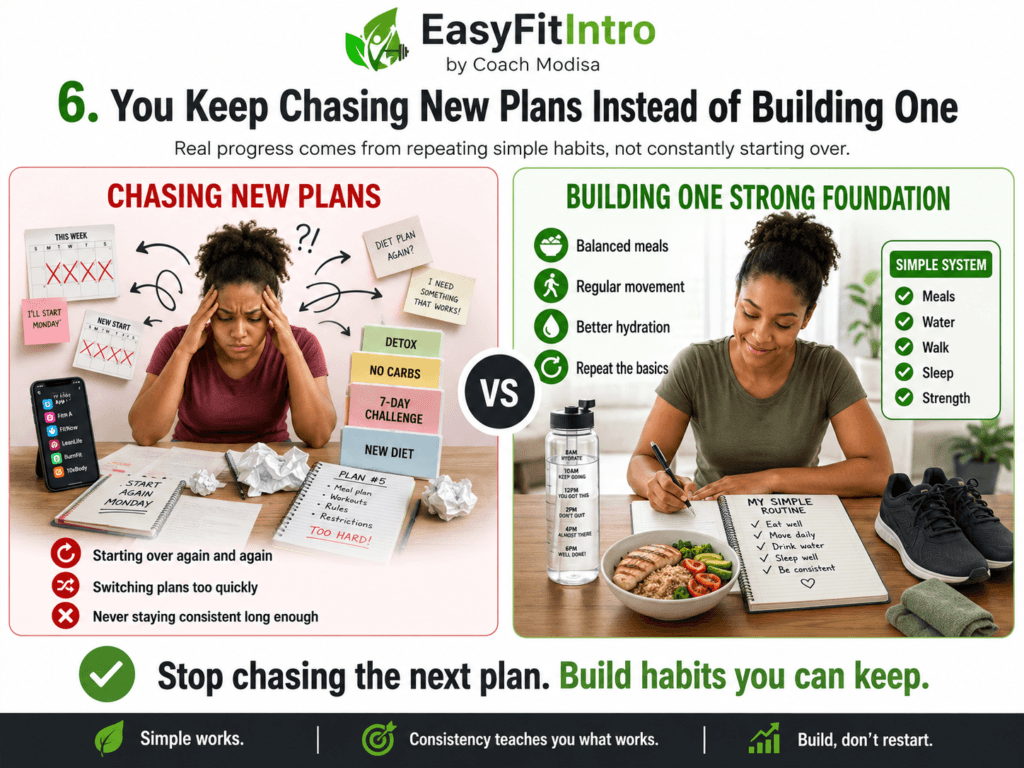
When progress feels slow, it becomes tempting to search for another diet.
Another challenge.
Another supplement.
Another workout.
Another “secret.”
This can create constant restarting.
You never stay with one sensible approach long enough to learn what actually works for you.
Before replacing your routine, ask whether you have followed the current basics consistently enough to judge them fairly.
For most beginners, the fundamentals are not complicated.
Balanced meals.
Adequate protein and fiber.
Regular movement.
Strength training.
Good hydration.
Enough sleep.
Stress management.
Consistency.
You do not need to constantly reinvent your health routine.
You need to practice the basics until they become normal.
7. You Measure Success Only by the Scale
The scale can be useful, but it should not control your entire mood.
If the number goes down, you feel successful.
If it stays the same, you feel defeated.
This can make you abandon good habits even when they are helping.
Track more than body weight.
Notice your waist measurement, energy, cravings, walking consistency, strength, sleep quality, and how your clothes fit.
Also track something even more important:
Are you becoming better at returning to your routine after a difficult day?
That may be one of the strongest signs that your approach is becoming sustainable.
The person who never makes mistakes does not exist.
The person who learns how to recover quickly becomes much harder to stop.
Stop Restarting—Start Continuing
Your weight loss journey does not have to keep returning to zero.
If breakfast was poor, improve lunch.
If today was difficult, make tomorrow better.
If you missed two workouts, do the next one.
If you ate more than planned, do not punish yourself by starving the following day.
Return to your normal routine.
The skill that changes everything is learning how to continue after imperfection.
That is what turns temporary effort into a lifestyle.
A Simple Rule for Beginners
Remember this:
Never let one difficult decision become permission for a difficult week.
Your next choice matters more than your previous mistake.
Drink the water.
Build the balanced meal.
Take the short walk.
Get some sleep.
Then continue.
You do not need to prove that you can be perfect.
You need to prove that you can return.
Coach Modisa’s Message
If you have restarted your weight loss journey many times, stop using that history as evidence that you cannot succeed.
Use it as information.
Look at what repeatedly caused you to stop.
Was the plan too strict?
Were you expecting results too quickly?
Did you rely entirely on motivation?
Did one difficult day become a lost week?
Once you understand the pattern, you can build a better system.
Your goal is not to create a routine you can survive for 14 days.
Your goal is to build habits you can still recognize months from now.
Start simple.
Stay consistent.
And when life knocks you out of rhythm, make the next healthy decision and keep moving.
Ready to Build a Routine You Can Actually Repeat?
If cravings, inconsistent meals, and stubborn belly fat keep pulling you back into the restart cycle, download the Free EasyFitIntro Belly Fat Reset Workbook.
It will help you start building simple habits around meals, hydration, movement, sleep, and daily consistency—without starvation diets or complicated routines.
Get your free Belly Fat Reset Workbook here:
EasyFitIntro content is for general educational purposes and is not a substitute for personalized medical advice. If you have a medical condition or concerns about weight, diet, or exercise, speak with an appropriate healthcare professional.