
Introduction
Have you ever reached for food even though you ate recently?
You may suddenly want chocolate after a stressful call, biscuits while watching television, or chips because you feel bored. At other times, your stomach feels empty, your energy drops, and almost any proper meal sounds satisfying.
Both experiences can feel like hunger, but they may not come from the same need.
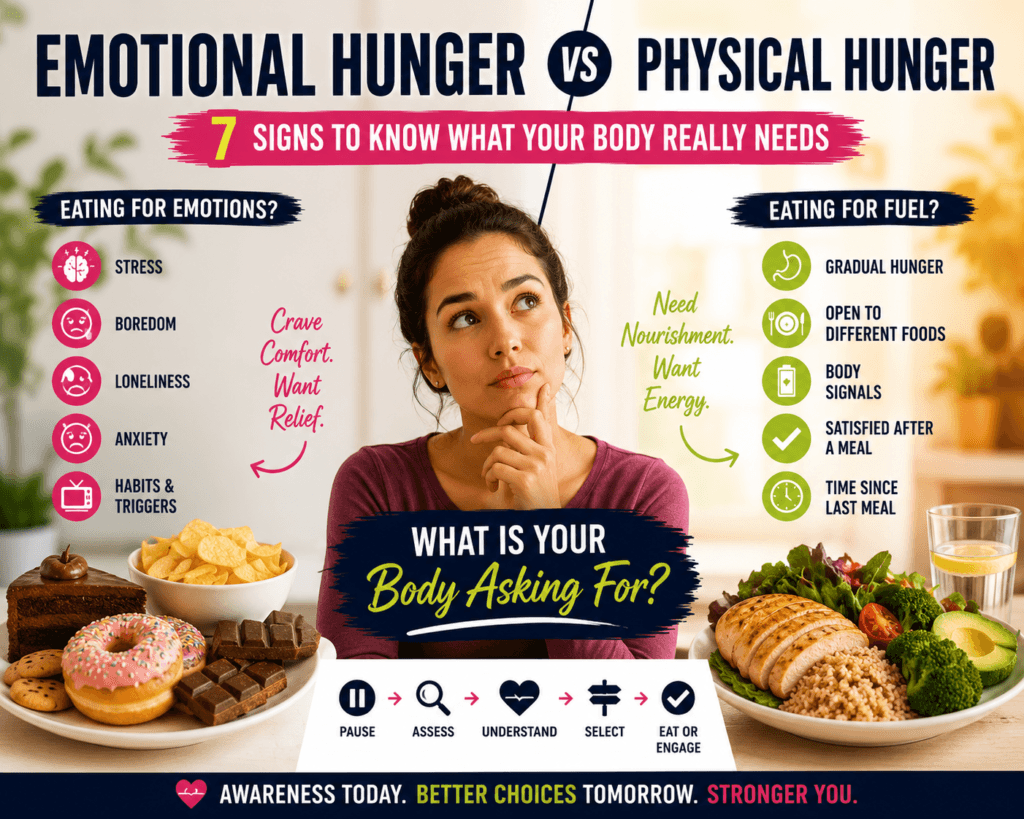
Physical hunger develops when your body needs nourishment and energy.
Emotional hunger describes an urge to eat that is influenced mainly by feelings, stress, boredom, habit, reward, or environmental triggers rather than a clear physical need for food.
The difference is not always obvious.
Physical and emotional hunger can appear together. You might be genuinely hungry while also wanting comfort. Poor sleep, aggressive dieting, skipped meals, and stress can make the signals even harder to understand.
This article will help you recognize seven common differences, respond without guilt, and choose what your body really needs.
Emotional Hunger Is Not a Character Flaw
Eating for comfort does not mean you are weak or undisciplined.
Food is connected to celebration, culture, family, reward, relaxation, and memory. Enjoying food emotionally is part of being human.
The problem develops when food becomes your main response to every difficult emotion.
A repeated pattern may look like this:
Stress → craving → eating → temporary relief → guilt or discomfort → more stress
The goal is not to remove all emotion from eating.
The goal is to notice when food is being asked to solve a problem it cannot fully solve.
Food can satisfy hunger.
It cannot permanently resolve loneliness, exhaustion, conflict, anxiety, boredom, or pressure.
What Does Physical Hunger Feel Like?
Physical hunger is your body’s signal that it needs food.
It may include:
- An empty or gently growling stomach
- Lower energy
- Difficulty concentrating
- Feeling irritable
- Mild weakness
- Thinking about several types of food
- Increasing hunger as more time passes
- Relief and satisfaction after eating
Physical hunger often develops after several hours without food, although the timing differs between people.
Exercise, body size, medication, sleep, health conditions, meal composition, and activity levels can all influence when hunger appears.
You do not need to wait until you feel weak or desperate before eating.
Extreme hunger often makes calm decision-making harder.
What Does Emotional Hunger Feel Like?
Emotional hunger is usually connected to an emotion, event, habit, or cue.
It may appear when you are:
- Stressed
- Bored
- Lonely
- Angry
- Anxious
- Tired
- Celebrating
- Procrastinating
- Watching television
- Scrolling social media
- Surrounded by tempting food
You may want one highly specific food rather than a balanced meal.
The food may offer temporary comfort, stimulation, distraction, or reward. But because the original emotional need remains, the urge can return even after your stomach is full.
Not everyone responds to emotions by eating more. Some people lose their appetite when stressed. Emotional responses to food differ from person to person.
Sign 1: Physical Hunger Usually Builds Gradually
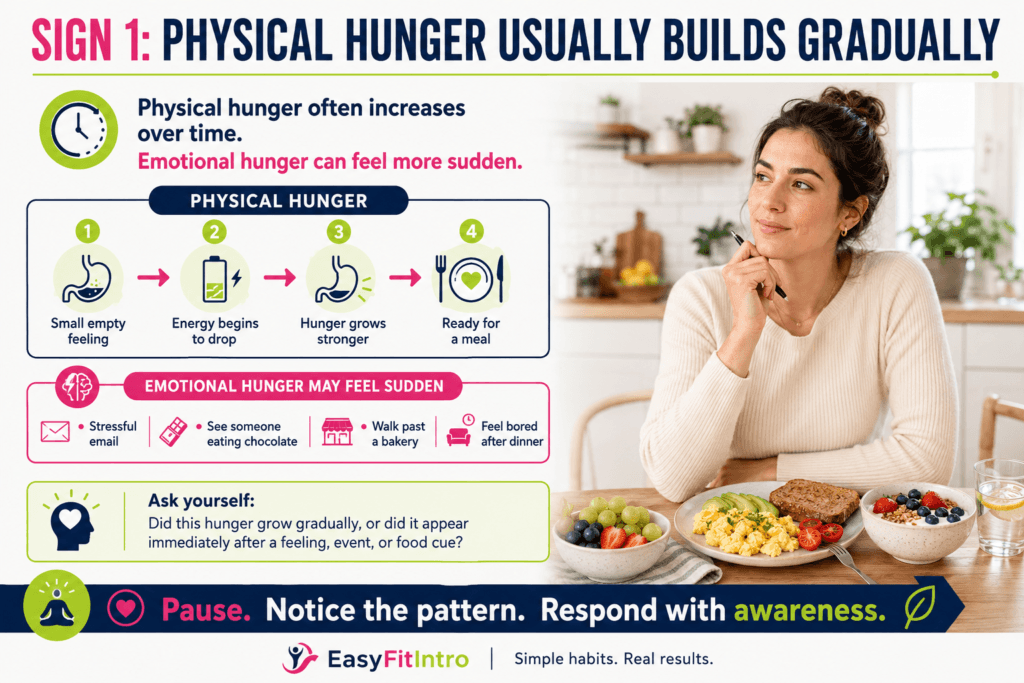
Physical hunger often increases over time.
You may first notice a small empty feeling. Later, your energy or concentration may begin to drop. If you continue delaying food, the hunger becomes stronger.
Emotional hunger can feel more sudden.
You may feel fine until something happens:
- A stressful email arrives.
- You see someone eating chocolate.
- You walk past a bakery.
- You start watching your favorite program.
- You feel bored after dinner.
Suddenly, the urge to eat feels urgent.
Ask Yourself
Did this hunger grow gradually, or did it appear immediately after a feeling, event, or food cue?
A sudden urge does not automatically prove that the hunger is emotional. But it gives you a reason to pause and investigate.
Sign 2: Physical Hunger Is Usually Open to Different Foods
When you are physically hungry, several foods may sound acceptable.
You may be willing to eat the following:
- Eggs
- Chicken
- Beans
- Yogurt
- Fruit
- Oats
- A sandwich
- Leftovers
- A proper meal
Emotional hunger is often more specific.
You do not simply want food. You want:
- Chocolate
- Biscuits
- Ice cream
- Chips
- Takeaways
- A sugary drink
- A particular pastry
This is sometimes called a specific craving.
Try the Proper-Meal Test
Ask:
Would I eat a normal balanced meal right now?
If the answer is yes, physical hunger may be present.
If the answer is, “No, but I desperately want chocolate,” the urge may be driven more strongly by emotion, habit, reward, or a food cue.
This is only a guide. You can be physically hungry and still prefer a particular food.
Sign 3: Physical Hunger Often Comes With Body Signals
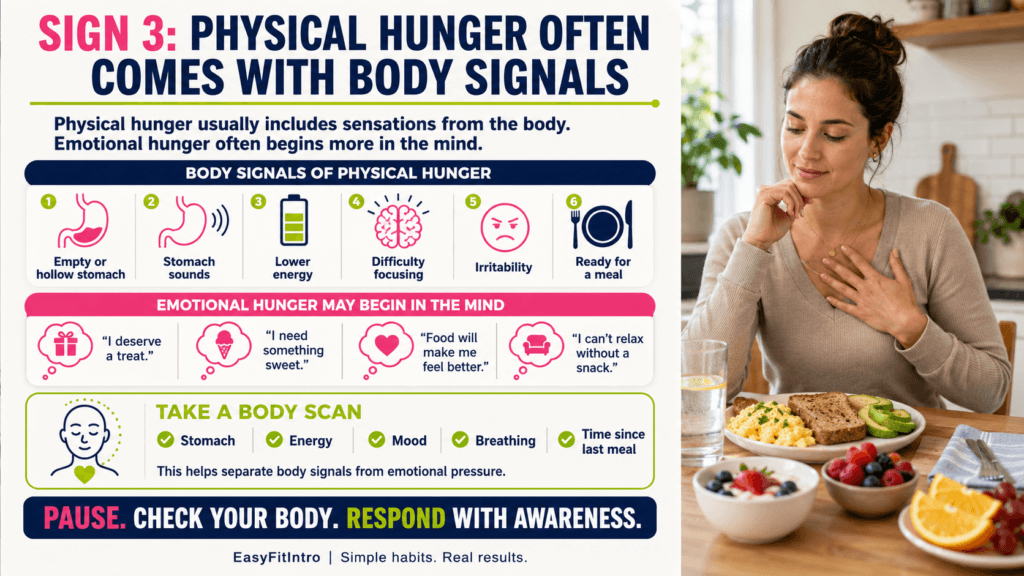
Physical hunger usually includes sensations from the body.
These may include:
- A hollow feeling
- Stomach sounds
- Reduced energy
- Mild weakness
- Difficulty focusing
- Irritability
- Feeling ready for a meal
Emotional hunger may begin more strongly in the mind.
You may repeatedly think:
- “I deserve a treat.”
- “I need something sweet.”
- “Food will make me feel better.”
- “I cannot relax without a snack.”
- “Today was terrible, so it does not matter.”
Your stomach may not feel empty, but the thought of eating becomes difficult to ignore.
Take a Body Scan
Pause for 30 seconds and notice:
- Your stomach
- Your energy
- Your mood
- Your breathing
- Muscle tension
- The time since your last meal
This helps separate physical sensations from emotional pressure.
Sign 4: Physical Hunger Is Satisfied by Enough Food
When physical hunger is met with a satisfying meal, the body normally begins to feel comfortable.
The hunger reduces. Food becomes less urgent. You can move on with your day.
Emotional hunger may continue even when the stomach is physically full.
You may finish eating but continue searching for something else because the food did not resolve the emotion that triggered the eating.
For example:
- Stress remains after the biscuits.
- Loneliness remains after the takeaway.
- Boredom returns after the chips are finished.
- Work pressure remains after the chocolate.
Ask Midway Through Eating
Is my body still hungry, or am I trying to maintain the feeling of comfort?
You do not have to stop immediately. The purpose of the question is awareness, not punishment.
Sign 5: Emotional Hunger Often Has a Clear Trigger
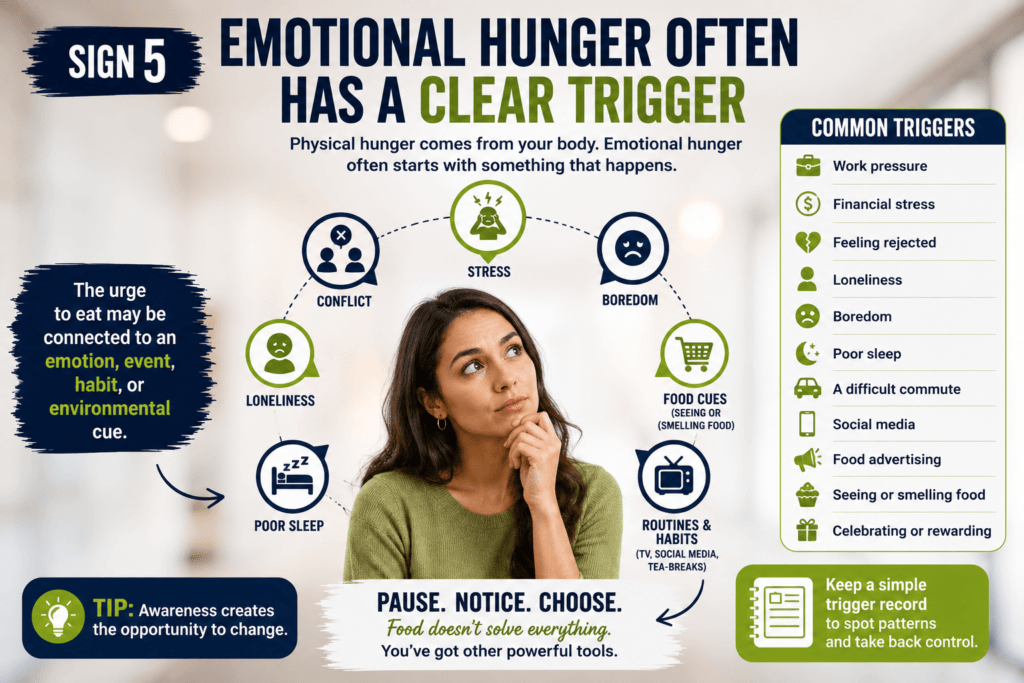
Physical hunger is usually connected to your body’s need for food.
Emotional hunger is often connected to something that happened.
Common triggers include:
- Conflict
- Work pressure
- Financial stress
- Feeling rejected
- Loneliness
- Boredom
- Poor sleep
- A difficult commute
- Social media
- Food advertising
- Seeing or smelling food
- A daily tea-break habit
The trigger may also be positive.
People sometimes eat to celebrate, reward themselves, or extend a pleasant experience even when they are already full.
Keep a Simple Trigger Record
When the urge appears, record:
- The time
- What happened just before it
- Your emotion
- Your hunger level
- The food you wanted
- What you eventually chose
After several days, repeated patterns usually become easier to see.
Sign 6: Emotional Hunger Often Feels Urgent
Physical hunger can become urgent if you have gone too long without eating.
However, moderate physical hunger often allows enough time to prepare or choose a meal.
Emotional hunger may feel like a command:
“I need this now.”
The urgency can make you feel as though you have no choice.
You may eat quickly, automatically, or without fully tasting the food.
Use the ten-minute test.
Tell yourself:
“I am allowed to eat this. I will first pause for ten minutes.”
During the pause:
- Drink some water.
- Step away from the food.
- Take a short walk.
- Breathe slowly.
- Identify the emotion.
- Reassess your physical hunger.
If you remain hungry, eat.
The pause is not designed to trick or starve you. It gives you enough space to move from an automatic reaction to a deliberate choice.
Sign 7: The Feeling After Eating May Be Different
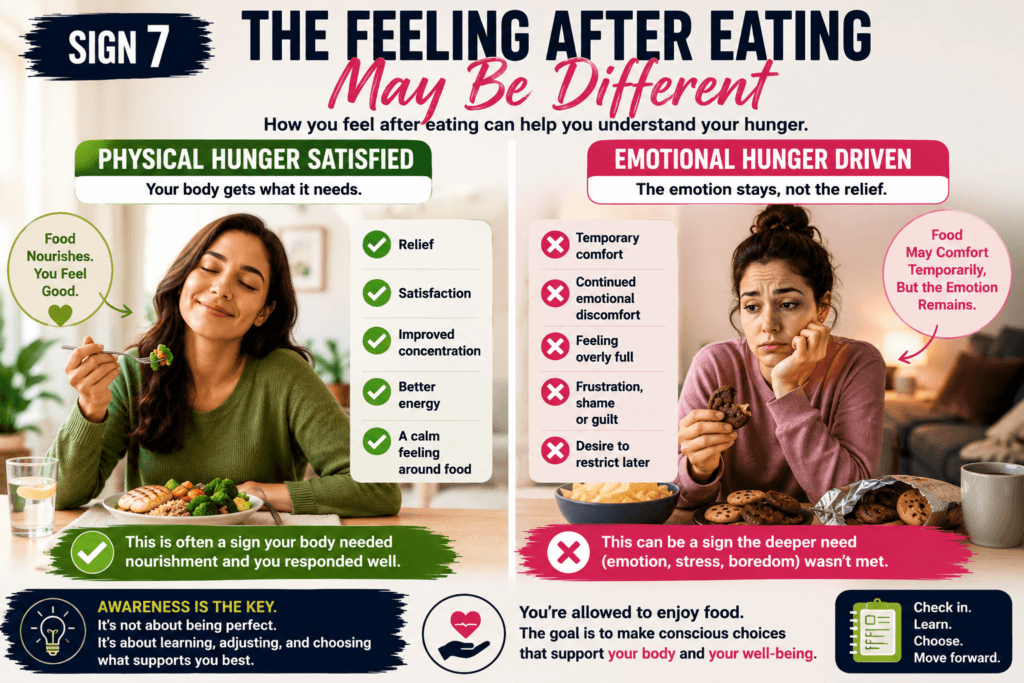
Physical hunger is often followed by the following:
- Relief
- Satisfaction
- Improved concentration
- Better energy
- A calm feeling around food
Emotional eating may be followed by the following:
- Temporary comfort
- Continued emotional discomfort
- Feeling overly full
- Frustration
- Shame
- Guilt
- A desire to restrict food later
Not every episode of emotional eating leads to guilt, and eating an enjoyable food is not wrong.
The warning sign is a repeated cycle in which food provides only brief relief and leaves you feeling worse afterward.
Important Reminder
Guilt does not improve eating behavior.
It often pushes people towards extreme restriction, which may create more hunger and another episode of overeating.
Respond with curiosity:
“What was I needing at that moment?”
That question is more useful than:
“What is wrong with me?”
Emotional Hunger vs Physical Hunger: Quick Comparison
| Physical Hunger | Emotional Hunger |
|---|---|
| Often develops gradually | May appear suddenly |
| Several foods sound acceptable | Often wants one specific food |
| Commonly includes body signals | Often begins with thoughts or emotions |
| Usually improves after enough food | May continue after physical fullness |
| Often related to time since eating | Often related to an event or cue |
| Can usually wait briefly | May feel urgent |
| Often ends in satisfaction | May provide only temporary relief |
These are common patterns, not strict rules.
Both types of hunger can exist at the same time.
The Hunger Scale: Check Before You Eat
Use a simple scale from 0 to 10:
0 – Extremely hungry, weak, or unwell
1 – Very hungry and struggling to focus
2 – Strong physical hunger
3 – Ready to eat
4 – Slightly hungry
5 – Neutral
6 – Comfortably satisfied
7 – Full
8 – Uncomfortably full
9 – Very uncomfortable
10 – Painfully full
A helpful goal is often to begin eating before reaching extreme hunger and to finish around comfortable satisfaction.
This is not a rigid rule.
Some days you will eat earlier. Some meals will leave you fuller than others. The scale is simply a tool for improving awareness.
Use the PAUSE method.
When you are unsure whether the hunger is physical or emotional, use this five-step check.
P — Pause
Take a moment before acting automatically.
A — Assess Your Body
Notice your stomach, energy, concentration, and the time since you last ate.
U — Understand the Emotion
Name what you feel:
- Stressed
- Bored
- Lonely
- Angry
- Tired
- Anxious
- Excited
S — Select the Real Need
Ask whether you need:
- A meal
- A balanced snack
- Water
- Rest
- Movement
- Comfort
- Connection
- A break
E — Eat or Engage Deliberately
Eat when food is the appropriate response.
Choose another supportive action when the need is emotional.
Either way, make the choice consciously rather than reacting automatically.
What to Do When the Hunger Is Physical
If you are physically hungry, eat.
Do not try to breathe, walk, or drink water until genuine hunger disappears.
Your body needs nourishment.
Choose a balanced meal or snack that includes protein and fiber where possible.
Balanced Meal Formula
Protein + vegetables or fruit + fibre-rich carbohydrates + healthy fats
Examples:
- Chicken, rice, and vegetables
- Eggs, potatoes, and salad
- Beans, pap, and spinach
- Tuna with whole-grain bread and vegetables
- Greek yogurt with oats and fruit
- Lentils with rice and mixed vegetables
Satisfying Snack Ideas
- Yogurt and fruit
- A boiled egg and an apple
- Nuts and fruit
- Peanut butter on whole-grain toast
- Maas and a banana
- Tuna and whole-grain crackers
- Cottage cheese and fruit
- Oats with milk
Delaying meals repeatedly or eating too little may make cravings and overeating harder to control later.
Read More Here: The Simple Meal Formula That Helps Reduce Cravings and Belly Fat Struggles
What to Do When the Hunger Is Emotional
If the need is emotional, identify what might help beyond food.
If You Are Stressed
Try:
- A short walk
- Deep breathing
- Stretching
- Prayer or meditation
- Writing down the problem
- Stepping away from your screen
If You Are Bored
Try:
- A quick household task
- Reading
- Calling someone
- Listening to music
- Going outside
- Starting a small creative activity
If You Are Lonely
Try:
- Messaging a trusted person
- Calling a family member
- Spending time around others
- Joining a supportive group
- Planning a social activity
If You Are Tired
Try:
- Resting
- Going to bed earlier
- Drinking water
- Reducing unnecessary tasks
- Taking a light walk for alertness
- Eating a proper meal if tiredness is combined with hunger
If You Want a Reward
Choose a reward that supports you:
- A warm shower
- Music
- A favourite programme
- Quiet time
- A walk
- A hobby
- A planned enjoyable food portion
Food can still be one of your rewards. It simply should not be the only one.
What If You Are Physically and Emotionally Hungry?
This happens often.
You may have skipped lunch and then had a stressful afternoon. By evening, your body needs food and your mind wants comfort.
Do not try to separate the two perfectly.
Start by feeding the physical hunger with a proper meal.
Then address the emotional need separately.
For example:
- Eat a balanced dinner.
- Wait until you feel physically satisfied.
- Take a short walk or shower.
- Talk about the stressful event.
- Decide calmly whether you still want dessert.
Trying to solve genuine hunger with distraction usually backfires.
Why Skipping Meals Can Make Emotional Eating Worse
Some people respond to overeating by skipping the next meal or severely restricting food.
This can strengthen the cycle.
The body becomes extremely hungry. Food thoughts increase. Then another stressful event or tempting food cue appears when your ability to make a calm decision is already reduced.
The pattern becomes:
Overeating → guilt → restriction → extreme hunger → overeating again
A better response is to return to your normal balanced eating pattern at the next meal.
One difficult eating moment does not require punishment.
How Poor Sleep Confuses Hunger Signals
Poor sleep can increase tiredness, stress, and the desire for quick-energy foods.
When you are exhausted, it may be difficult to determine whether you need food, rest, caffeine, or emotional relief.
You may reach for sugar because it offers temporary energy.
The solution is not to ignore hunger.
Instead:
- Eat regular balanced meals.
- Drink water.
- Use caffeine carefully.
- Avoid chasing every energy drop with sugar.
- Protect the next night’s sleep.
Read More Here: Poor Sleep and Belly Fat: Why Cravings Feel Harder to Control When You’re Tired
How Your Environment Creates “Hunger”
Sometimes you begin thinking about food because it is visible, available, or connected to a routine.
Examples include:
- Biscuits on your desk
- Sweets near the checkout
- Food advertisements
- Smelling takeaway food
- Snacking whenever you watch television
- Buying chocolate at the same shop after work
This is not necessarily physical hunger.
It may be a learned cue.
Change the Environment
Make the supportive choice easier:
- Keep water visible.
- Store snacks out of sight.
- Pack a balanced option.
- Avoid shopping while extremely hungry.
- Change your route past a trigger shop.
- Eat from a plate instead of the packet.
- Create a new tea-break routine.
Read More Here: Why You Crave Sugar in the Afternoon: 7 Hidden Causes and What to Do Instead
Emotional Hunger and Belly Fat
Emotional hunger does not directly create belly fat.
However, repeated eating beyond your body’s energy needs may make maintaining a calorie deficit more difficult.
Belly fat is also influenced by:
- Overall food intake
- Physical activity
- Sleep
- Stress
- Genetics
- Age
- Sex
- Hormones
- Alcohol intake
- Medical conditions
Learning to respond differently to emotional hunger is one part of a broader fat-loss system.
The goal is not to become emotionally perfect.
It is to reduce automatic eating and create more conscious choices.
Common Mistakes When Managing Emotional Hunger
1. Judging Yourself
Shame makes it harder to understand the trigger.
Use curiosity instead.
2. Trying to Remove Every Enjoyable Food
Strict rules can increase food obsession and make cravings stronger.
3. Ignoring Genuine Hunger
Do not label every craving as emotional. Your body may simply need food.
4. Skipping the Next Meal
Return to normal eating instead of punishing yourself.
5. Relying Only on Willpower
Change your environment and prepare better options.
6. Expecting the Craving to Disappear Immediately
A craving can rise and fall gradually. You do not have to react at its strongest point.
7. Using Food as Your Only Coping Tool
Build a wider list of ways to deal with stress, boredom, sadness, and fatigue.
A Seven-Day Hunger Awareness Challenge
For the next seven days, record one eating urge each day.
Write down:
- The time
- Your hunger level from 0 to 10
- The time of your previous meal
- What happened before the urge
- Your emotion
- The food you wanted
- Whether several foods sounded acceptable
- What you chose
- How you felt afterward
At the end of the week, look for patterns.
You may discover that:
- Afternoon cravings follow a small lunch.
- Night eating happens after stressful days.
- Biscuits are connected to tea rather than hunger.
- Poor sleep makes every craving stronger.
- You wait too long between meals.
- Social media triggers takeaway cravings.
Awareness creates the opportunity to change.
Example: Physical Hunger
You ate breakfast at 7:00 AM and have been working since then.
At 12:30 PM:
- Your stomach feels empty.
- Your energy is lower.
- Chicken, beans, eggs, or a sandwich all sound acceptable.
- The hunger has grown gradually.
This is probably physical hunger.
A proper lunch is the correct response.
Example: Emotional Hunger
You finished dinner an hour ago.
Then you receive a stressful message.
Suddenly:
- You want chocolate.
- Nothing else sounds satisfying.
- Your stomach does not feel empty.
- The urge feels urgent.
- You believe the chocolate will calm you.
This may be emotional hunger.
Pause, address the stress, and then decide whether you still want the chocolate.
You are still allowed to eat it.
The win is making the choice consciously.
Related EasyFitIntro Guides
Continue strengthening your cravings and belly fat system with these guides:
- Why You Crave Sugar in the Afternoon: 7 Hidden Causes and What to Do Instead
- Late-Night Snacking and Belly Fat: Why Cravings Get Worse After Dinner
- Poor Sleep and Belly Fat: Why Cravings Feel Harder to Control When You’re Tired
- Not Getting Enough Protein? Why Belly Fat and Cravings Feel Harder to Control
- Why You’re Always Hungry After Eating: The Blood Sugar–Craving Cycle Explained
- The Simple Meal Formula That Helps Reduce Cravings and Belly Fat Struggles
- 7 Morning Habits That Reduce Cravings and Support Belly Fat Loss
- The Hidden Reasons Your Belly Fat Doesn’t Go Away (Even When You’re Doing Everything Right)
Spread the links naturally through the relevant article sections. Keep this related-guides section near the end for readers who want to continue learning.
The Bottom Line
Physical hunger means your body needs nourishment.
Emotional hunger means an emotion, habit, reward, or environmental cue is influencing the urge to eat.
The seven common differences involve the following:
- How quickly the hunger appears
- Whether several foods sound acceptable
- Whether you notice physical body signals
- Whether enough food satisfies the urge
- Whether an emotion or event triggered it
- Whether the craving feels urgent
- How you feel after eating
These signs are not perfect rules.
Physical and emotional hunger can overlap.
The goal is not to analyze every bite or become afraid of comfort food. It is to create a small pause between the urge and the action.
Ask:
What does my body need?
What am I feeling?
Will food solve this need?
What response will support me best?
Sometimes the answer will be a proper meal.
Sometimes it will be rest, movement, comfort, connection, or a break.
And sometimes you may consciously choose the food you want and enjoy it without guilt.
That is not failure.
That is awareness and balance.
Free Belly Fat Reset Workbook
Want help turning better food, sleep, movement, and stress habits into a simple daily routine?
Download the free Belly Fat Reset Workbook from EasyFitIntro.
It includes beginner-friendly checklists and practical steps that can help you manage cravings, improve consistency, and build a more sustainable belly fat routine.
Get My Free Belly Fat Reset Workbook
Link the button to the Belly Fat Reset Workbook landing page.
Frequently Asked Questions
What is the main difference between physical and emotional hunger?
Physical hunger is driven mainly by the body’s need for nourishment. Emotional hunger is influenced more strongly by emotions, habits, reward, or environmental cues.
Can emotional hunger feel physically real?
Yes. Emotions can produce strong physical sensations and urges. That is why a brief pause and body check can be helpful.
Can I be physically and emotionally hungry at the same time?
Yes. You might need food while also seeking comfort. Feed the physical hunger first, then address the emotional need.
Is it bad to eat for comfort?
No. Eating for comfort occasionally is normal. It becomes a concern when it is your main coping strategy or causes repeated distress and loss of control.
How do I stop emotional eating immediately?
There is rarely one instant solution. Begin by identifying triggers, eating enough during the day, improving sleep, changing your environment, and developing other coping strategies.
Should I drink water instead of eating?
Only when you are thirsty rather than hungry. Water should not be used to suppress genuine physical hunger.
Does a specific craving mean the hunger is emotional?
Not always. Physical hunger and food preferences can coexist. A specific craving is simply one clue to consider.
Why do I feel guilty after eating?
Guilt may come from strict food rules, feeling out of control, or believing that certain foods are morally “bad.” One eating choice does not determine your progress.
Can emotional eating cause belly fat?
Emotional eating does not target belly fat directly. However, repeated eating beyond your energy needs can contribute to overall fat gain over time.
When should I get professional help?
Seek support if eating frequently feels uncontrollable; you eat unusually large amounts in a short time, hide your eating, regularly compensate through fasting or excessive exercise, or experience significant distress around food.
Medical Note
This article provides general educational information and is not a substitute for medical, psychological, or nutritional care.
Speak with a qualified healthcare professional if you experience:
- Repeated loss-of-control eating
- Eating unusually large amounts in a short period
- Frequent eating when uncomfortably full
- Hiding food or eating secretly
- Vomiting, fasting, or excessive exercise to compensate
- Severe guilt, anxiety, or distress around eating
- Unexplained changes in hunger or weight
- Symptoms of diabetes or another medical condition
A registered dietitian, psychologist, doctor, or qualified eating-disorder professional can help you understand the pattern without judgment.
Get My Free Belly Fat Reset Workbook
Science and source guidance
Emotional eating is commonly described as eating in response to emotions rather than physical hunger, but research also shows that people respond differently to emotions: some eat more, some eat less, and emotional-eating questionnaires do not always predict actual food intake consistently. That is why the article presents its seven signs as helpful clues rather than diagnostic rules.
Research links emotional eating with interactions between emotion regulation, food reward, internal hunger and fullness cues, and environmental or psychological triggers. The evidence is complex, so the article avoids claiming that every craving has one simple cause.
Skipping meals or not eating enough can contribute to later overeating or loss-of-control eating for some people. This supports the article’s recommendation to feed genuine physical hunger rather than treating every eating urge as emotional.
Mindful and intuitive-eating approaches may help people become more aware of internal cues and automatic eating patterns, although reviews note that the evidence varies and stronger research is still needed.
Frequent episodes involving unusually large amounts of food and a sense of being unable to control eating may require professional assessment for binge-eating disorder or another eating concern.